


Final Exam — Chapters 1–11
The final covers Chapters 1 through 11 and will be similar in format to the first four exams. Review previous tests and understand the concepts behind any missed questions.
Questions? Email Professor Hoffman.
Fall 2026 — Final Exam Schedule
The original page contains May 2026 dates from a previous semester, which do not apply to Fall 2026. The final exam date and time for each class section must be confirmed against the official college schedule.
| Class section | Final exam date | Final exam time |
|---|---|---|
| Monday / Wednesday • 1:40–2:50 p.m. | To be confirmed | Check official schedule |
| Monday / Wednesday • 3:05–4:20 p.m. | To be confirmed | Check official schedule |
Grading and exam policies
60%
Four regular exams combined
30%
Comprehensive final exam
10%
Homework and classroom participation
- Four regular exams plus one final: five exams total.
- The lowest exam grade is not automatically dropped.
- As stated in the supplied course notes, the final exam grade replaces a missed regular exam grade; there are no make-up exams.
- No extra credit. Exams are graded on a 0–100 scale. Academic dishonesty may result in a zero, subject to college policy.
- Regular exams are held during class time. Final exam timing follows the college's official final schedule.
Review all 11 chapters
Read the textbook chapters alongside your class notes. Use the links below to review diagrams, videos and key concepts.
Study tip: Give extra attention to Chapters 4 and 9, as emphasized in the original final review.
Final exam study priorities
- Seasons, latitude and solar energy — Chapter 2: Know the current season, upcoming season, latitude lines, the sun's position and changing daylight. Review textbook pages 30–40.
- Atmospheric layers — Chapter 1: Understand what makes each layer distinctive. Review the thermal structure of the atmosphere, pages 16–20, and Figure 1.20 on page 18.
- Stable and unstable air — Chapter 4: Compare an air parcel's temperature with its environment. Know the environmental lapse rate and how to draw and interpret a stability chart. Review pages 100–104.
- Clouds and precipitation — Chapters 4–5: Connect unstable air with cloud development and precipitation types. Review pages 116–121.
- Winds and pressure systems — Chapters 6–7: Know clockwise and counterclockwise circulation, surface winds versus winds aloft, and how weather systems move.
- Air masses and fronts — Chapters 8–9: Understand air-mass characteristics, low-pressure weather patterns, frontal boundaries and associated weather.
- Midlatitude cyclones — Chapter 9: Predict wind direction, clouds and precipitation based on location relative to a low-pressure center. Review pages 241–243.
- Severe weather — Chapters 10–11: Know the basic concepts of thunderstorms, tornadoes and hurricanes.
- Weather around a low: Explain how conditions differ at various points surrounding a low-pressure system.
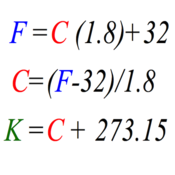
- Temperature conversions — Chapter 3: Practice converting between Fahrenheit and Celsius.
Practice: Analyze a weather map
Look at the map and describe the expected conditions at different locations around the low-pressure center and frontal boundaries.
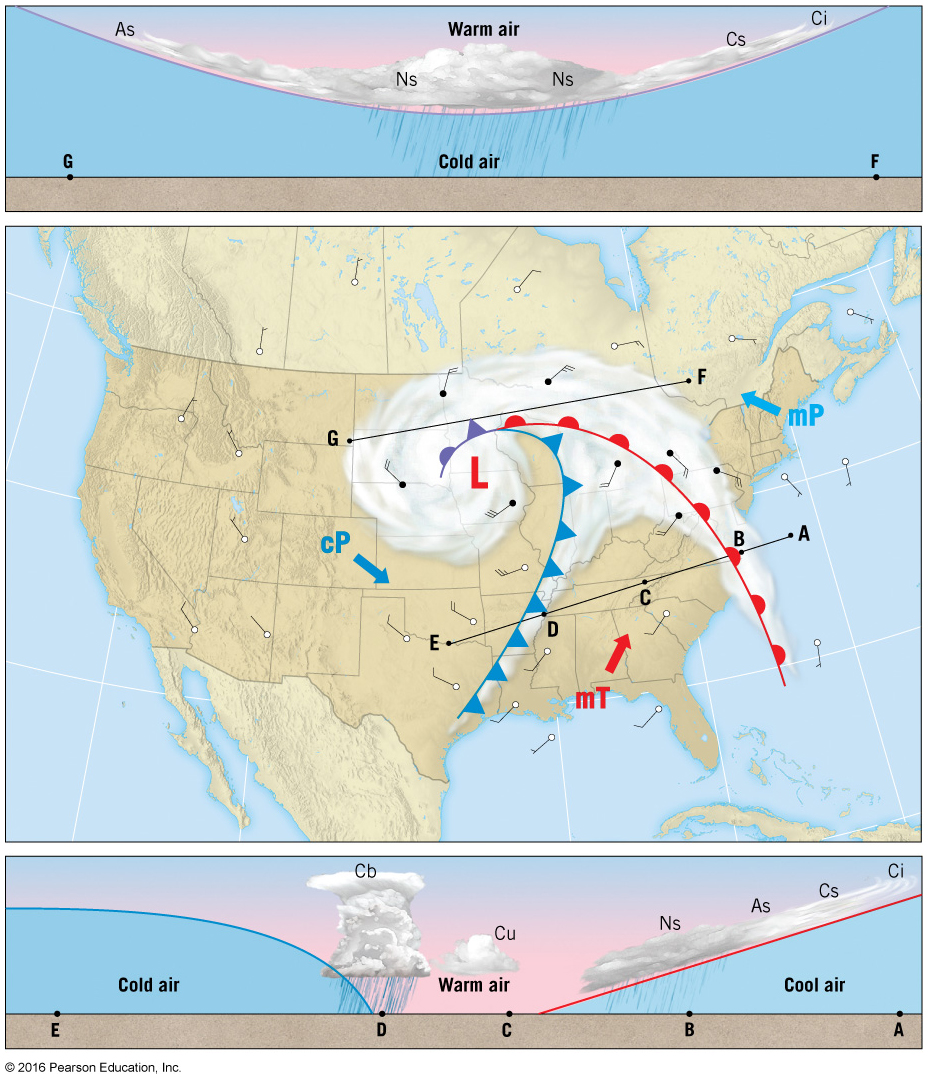
For each location, answer: What direction is the wind blowing? Which air mass is present? What clouds and weather are likely? Could precipitation occur, and what type? Is the air relatively warm or cold?
Temperature conversion practice
Formulas: °F = (°C × 9/5) + 32; °C = (°F − 32) × 5/9.
Final exam review video
Watch the original final review lesson and use it with your notes and previous exams.